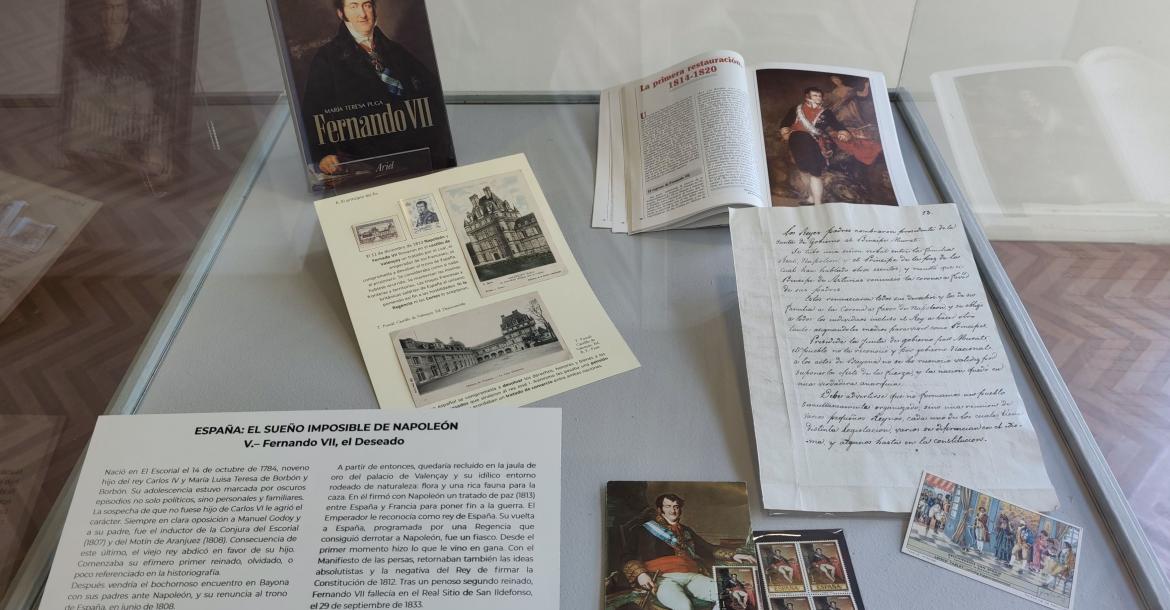
Over the last five consecutive years, to mark the commemoration of the Battle of Chiclana, the Chiclana Museum has annually featured as its ‘Exhibit of the Month’ a new instalment of the original project by José Luis Aragón Panés, the town’s official chronicler, entitled ‘Spain: Napoleon’s Impossible Dream’. Under this title, the intricacies of that episode have gradually been unravelled through complementary monographs – on figures and events – from the key factors behind its origins to the consequences of its outcome.
This year, the exhibition focuses on Ferdinand VII, hence the subtitle of this new instalment of “Napoleon’s Impossible Dream” is “Ferdinand VII, the Desired One”, of whom Aragón Panés tells us that “he was born in El Escorial on 14 October 1784, the ninth child of King Charles IV and Maria Luisa Teresa of Bourbon and Bourbon. His adolescence was marked by dark episodes, not only political but also personal and familial. The suspicion that he was not the son of Charles VI embittered his character. Always in clear opposition to Manuel Godoy and his father, he was the instigator of the Conspiracy of El Escorial (1807) and the Mutiny of Aranjuez (1808). As a result of the latter, the old king abdicated in favour of his son. Thus began his short-lived first reign, forgotten or scarcely mentioned in historiography.”
This was followed by “the humiliating meeting in Bayonne with his parents in the presence of Napoleon, and his abdication from the Spanish throne in June 1808. From then on, he was confined to the ‘golden cage’ of the Palace of Valençay and its idyllic surroundings, surrounded by nature: flora and a rich variety of game. There, he signed a peace treaty (1813) with Napoleon between Spain and France to bring the war to an end. The Emperor recognised him as King of Spain. His return to Spain, organised by a Regency that had managed to defeat Napoleon, was a fiasco. From the very outset, he did as he pleased. With the Manifesto of the Persians, absolutist ideas also returned, along with the King’s refusal to sign the Constitution of 1812. After a troubled second reign, Ferdinand VII died at the Royal Site of San Ildefonso on 29 September 1833”.
The chronicler’s words are presented to the public, as is customary, supported by period documents, philatelic items, collectables and bibliographic works, all of which are brought together and exhibited.
This new instalment of “Spain: Napoleon’s Impossible Dream” will be on display to the public from the significant date of 5 March.